9 Best wireless microphones for stage use for Singers Who Need Freedom Without Dropouts
A wireless microphone buys a singer two things — the run across the stage and the trust that the note will still be there when they land. The best wireless microphones for stage use earn that trust with clean frequency management, diversity antennas that shrug off dead spots, and capsules that carry the voice over a full band without a fight.
The market splits neatly into three tiers: legendary-brand systems that venues already trust, dual-handheld kits that cover a whole front line in one box, and modern hybrids that push range and battery life further each year. What separates a good system from a dropout machine is rarely the range printed on the box — it is the antenna design, the capsule, and how the system behaves when the venue’s airwaves are already crowded.
The nine systems below cover every tier of that map, from the SM58 capsule every singer recognizes to true-diversity dual kits that cost less than one legacy handheld. Each earns its place among the best wireless microphones for stage use — the right one depends on your voice, your venue, and how many singers share it.
Quick Picks
Best Overall: Shure BLX24/SM58 Wireless Vocal Microphone System
The legendary SM58 capsule cut free from the cable, with one-touch scan and the brand every venue trusts.
👉 Sing Through the Shure BLX24/SM58 on Amazon
Best Budget: CAD Audio WX200 UHF Dual Handheld Microphone System
Two synchronized handhelds and a dual-receiver that put a whole vocal duo on air for one friendly figure.
👉 Double Up with the CAD Audio WX200 on Amazon
Best Premium: AUDIX AP41 OM2 Handheld Wireless Microphone System
The Performance Series pairing Audix’s beloved OM2 capsule with a true-diversity rack-ready receiver.
👉 Go Pro With the AUDIX AP41 OM2 on Amazon
Best for Two Singers: Phenyx Pro PTAU-2 Dual True Diversity Wireless Microphone System
Two handhelds, four antennas, and auto-scanning that keeps both voices clean through a full set.
👉 Harmonize with the Phenyx Pro PTAU-2 on Amazon
Comparison Table
| Product Name | Key Feature | Price Range | Link |
|---|---|---|---|
| Shure BLX24/SM58 Wireless Vocal Microphone System | The SM58 capsule with one-touch scanning | Mid | Check Price on Amazon |
| Sennheiser XSW 1-825-A Vocal Wireless Microphone | e825-style capsule with automatic frequency management | Mid | View Deal on Amazon |
| Audio-Technica ATW-1102 Wireless Handheld Microphone System | 24-bit digital operation in the license-free band | Mid | See Offer on Amazon |
| AKG WMS420 Vocal Set | D5 capsule with rack-mountable receiver | Premium | Check Offer on Amazon |
| Samson Concert 88x Handheld UHF Wireless System Q7 | Q7 dynamic capsule with IR sync | Budget | See Details on Amazon |
| AUDIX AP41 OM2 Handheld Wireless Microphone System | OM2 capsule with true-diversity receiver | Premium | Explore Price on Amazon |
| Phenyx Pro PTAU-2 Dual True Diversity Wireless Microphone System | Dual true diversity with auto scan | Premium | View Option on Amazon |
| Xvive M5 Professional Wireless Handheld Microphone System | Built-in gain boost with a pocket receiver | Budget | See Price on Amazon |
| CAD Audio WX200 UHF Dual Handheld Microphone System | Two synced handhelds on independent channels | Budget | Check Details on Amazon |
Buyer’s Guide
1. Frequency Bands Decide Where You Can Perform
Wireless mics share the airwaves with TV broadcasts, Wi-Fi, and every other system in the building, and the band a system operates in decides how crowded that sky is. UHF systems with selectable frequencies let you dodge interference night by night, digital systems in the license-free band trade coordination for simplicity, and the honest rule is to match the band to your circuit — touring acts need scan-and-move flexibility, resident performers need one clean channel that stays clean.
2. Diversity Antennas Are What Actually Stop Dropouts
Dropouts happen when the signal reflects off walls and arrives out of phase, and the fix is diversity reception — two antennas feeding a receiver that switches to whichever hears the transmitter better. True diversity goes further with fully independent receiver chains, which is why the dual-antenna systems here hold up in block-walled bars where single-antenna units stutter. If your stage has pillars, a concrete back wall, or a walk-behind-the-PA moment, diversity is not a feature, it is the feature.
3. The Capsule Is Half the Purchase
A wireless system is only as good as the microphone bolted to the transmitter. The SM58, the D5, the OM2, and the Q7 are all proven stage capsules with devoted followings — each colors the voice differently, and each has a house style: the SM58 balanced and forgiving, the D5 bright and cutting, the OM2 present and feedback-hostile. Singers should pick the capsule they would buy wired, then let the wireless layer be the convenience instead of the compromise.
4. Battery Life and Coordination Make or Break a Set
Real gigs run three hours plus soundcheck, and a transmitter that dies at the encore is the most avoidable disaster in live music. Check honest battery figures, keep spares in the case, and if more than one wireless system shares the stage, make sure they can sit on different frequencies — or different bands — without walking on each other. The systems here that auto-scan and sync over infrared turn that chore into a two-minute ritual.
One Mistake to Avoid: Stacking Multiple Systems on the Same Frequencies
The second wireless mic bought on a whim is the one that kills both. Two systems factory-set to the same channel fight each other with pops and dropouts that no receiver setting can fix after the fact. Before buying, confirm every system on stage can move to its own clean frequency — scan-and-sync units and different-band pairings coexist happily, and five minutes of coordination at soundcheck protects the whole vocal rig.
9 Best wireless microphones for stage use for Singers Who Need Freedom Without Dropouts
Nine systems, nine answers to the same demand: sing anywhere on stage and sound identical everywhere. The Shure and Sennheiser carry the legacy capsules, the Audio-Technica goes digital, the AKG and Audix bring premium voicing, the Samson and CAD keep it honest at the entry, the Phenyx covers two singers in one rack, and the Xvive rethinks the receiver entirely. Here is how the list breaks down.
1. Shure BLX24/SM58 Wireless Vocal Microphone System
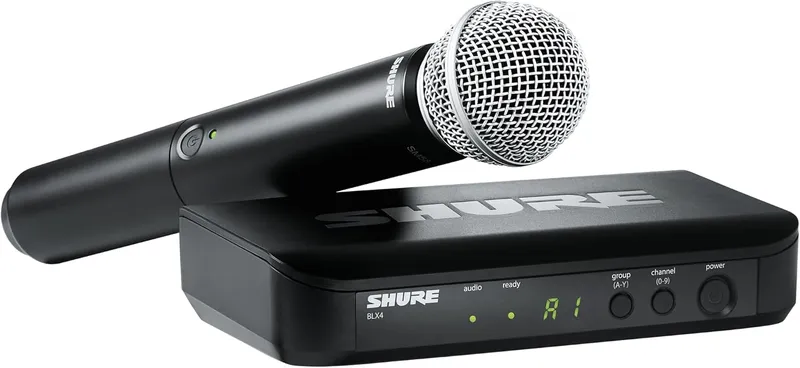
Best for: Singers who want the world’s most trusted vocal mic, unplugged from the cable.
- The SM58 capsule: The industry-standard vocal sound, built into the BLX2 handheld transmitter.
- One-touch QuickScan: The receiver finds the cleanest frequency before the soundcheck ends.
- BLX4 diversity receiver: Dual antennas that hold the signal through a full stage wander.
- Three-hundred-foot range: Line-of-sight operation that covers club stages with room to spare.
- Two-way battery door: A transmitter that takes standard cells and closes like a wired SM58.
Pros:
- The capsule every singer, engineer, and audience already knows.
- Frequency management that a first-time operator can run in seconds.
- Venue credibility that makes stage plots and house techs nod instantly.
Cons:
- Mid-tier receiver without networked control.
- Transmitter battery door needs careful handling over years.
- No rack hardware included for multi-system rigs.
Lead the Band with the Shure BLX24/SM58
2. Sennheiser XSW 1-825-A Vocal Wireless Microphone
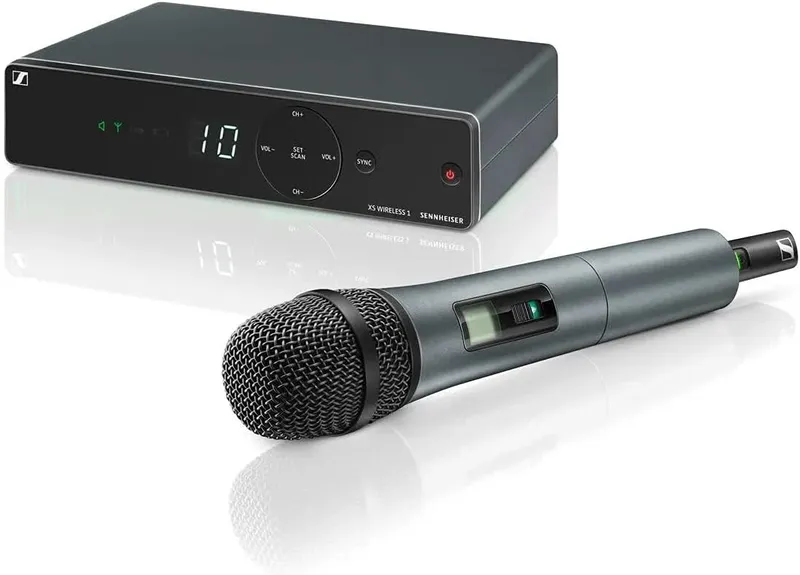
Best for: Singers who want German voicing with zero-fuss operation.
- e825-style capsule: The warm, feedback-disciplined Sennheiser vocal character on a wireless handheld.
- Automatic frequency management: The receiver scans and locks a clean channel on its own.
- One-touch infrared sync: The handheld learns the receiver’s settings in a single press.
- Half-rack metal receiver: Antennas front and back with a display built for dark stages.
- A-band operation: A frequency range tuned for the crowded club environment.
Pros:
- The most set-and-forget operation of the legacy brands here.
- A capsule voicing that sits vocals forward without harshness.
- Build quality that reads professional in any rack.
Cons:
- Fixed band limits coordination with same-band systems.
- No onboard EQ shaping of the capsule.
- Display is compact for front-of-house distance reading.
Own the Stage with the Sennheiser XSW 1-825-A
3. Audio-Technica ATW-1102 Wireless Handheld Microphone System
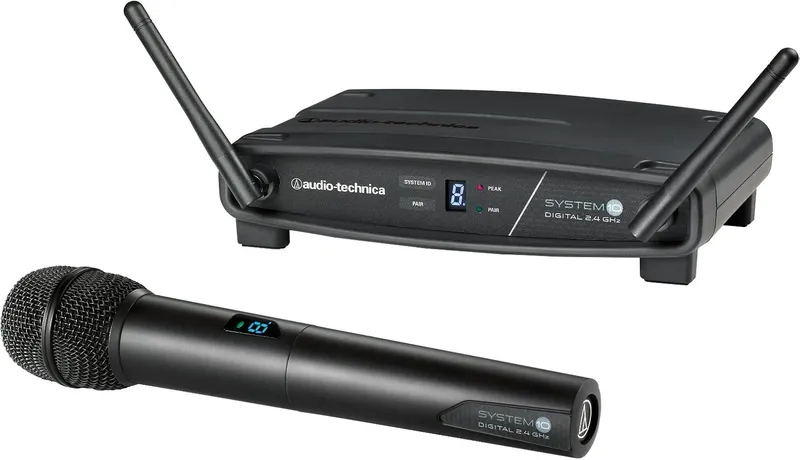
Best for: Singers who want digital clarity without frequency licensing worries.
- System 10 digital platform: 24-bit operation that keeps the signal clean end to end.
- License-free band operation: No frequency coordination paperwork or TV-band complications.
- Automatic interference avoidance: The system hops channels when the airwaves get busy.
- ATW-T1002 handheld: A balanced dynamic capsule with a mute switch under the thumb.
- Stackable receiver design: Multiple systems rack into one tidy column.
Pros:
- The simplest multi-system story here — stack them and they coordinate themselves.
- Digital consistency that never hisses or drifts across the room.
- Reset-anywhere operation that suits schools, houses of worship, and touring duos alike.
Cons:
- 2.4GHz band shares air with Wi-Fi in packed venues.
- Range is shorter than the UHF flagships.
- Receiver lacks rack ears without an optional kit.
Cut the Cable with the ATW-1102
4. AKG WMS420 Vocal Set
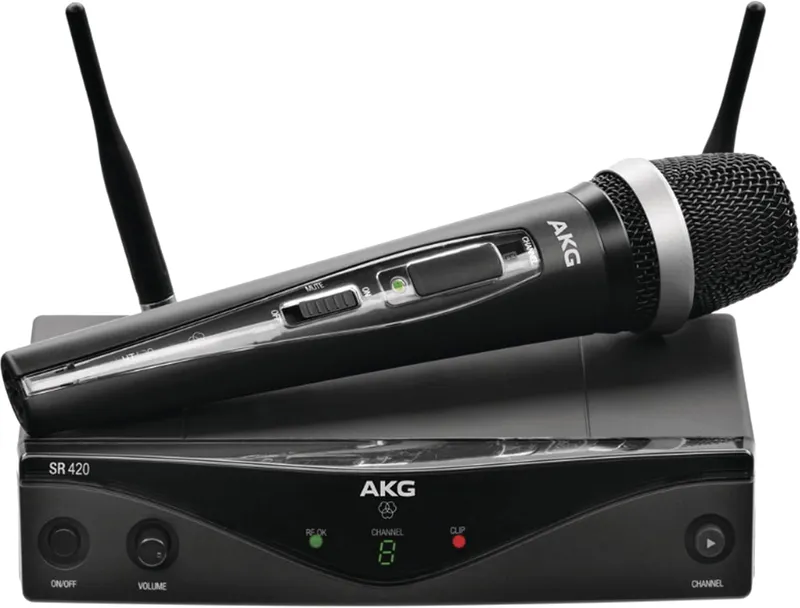
Best for: Vocalists who want a bright, cutting capsule with pro receiver control.
- D5 dynamic capsule: The concert-grade AKG voicing with a dual shock mount inside.
- SR420 true-diversity receiver: Rack-ready half-rack with squelch and volume under physical knobs.
- Selectable frequencies: Multiple switchable channels for multi-system coordination.
- HT420 handheld transmitter: Mute switch, battery indicator, and a solid metal body.
- Rack-mount hardware included: The kit that installs like house equipment from day one.
Pros:
- A capsule presence that cuts through loud stages without shouting.
- Receiver controls that engineers can dial without menus.
- Installation-grade hardware for permanent venues.
Cons:
- The premium of the single-channel UHF sets here.
- Capsule brightness flatters some voices more than others.
- Receiver antennas are fixed rather than detachable.
5. Samson Concert 88x Handheld UHF Wireless System Q7
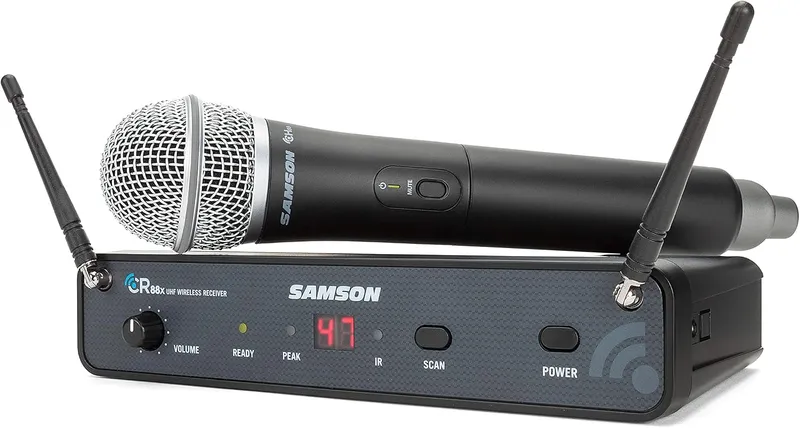
Best for: Working singers who want proven UHF reliability at the sensible end of the ladder.
- Q7 dynamic capsule: Samson’s stage-proven handheld with a warm, balanced response.
- Concert 88x receiver: True-diversity UHF reception with a ten-channel range.
- Infrared set sync: The transmitter pairs to the receiver channel in one press.
- Switchable frequencies: Ten selectable channels that sidestep a crowded airwave night.
- Battery indicator on the handheld: The LED that warns before the encore gamble.
Pros:
- Genuine UHF diversity operation at the friendliest legacy-brand figure here.
- Capsule that flatters spoken warmth and sung midrange alike.
- Operation simple enough for guest vocalists to use unaided.
Cons:
- Plastic transmitter feels lighter than the metal handhelds above.
- Ten channels fill quickly on multi-act bills.
- No rack hardware in the box.
Grab the Mic with the Samson Concert 88x
6. AUDIX AP41 OM2 Handheld Wireless Microphone System
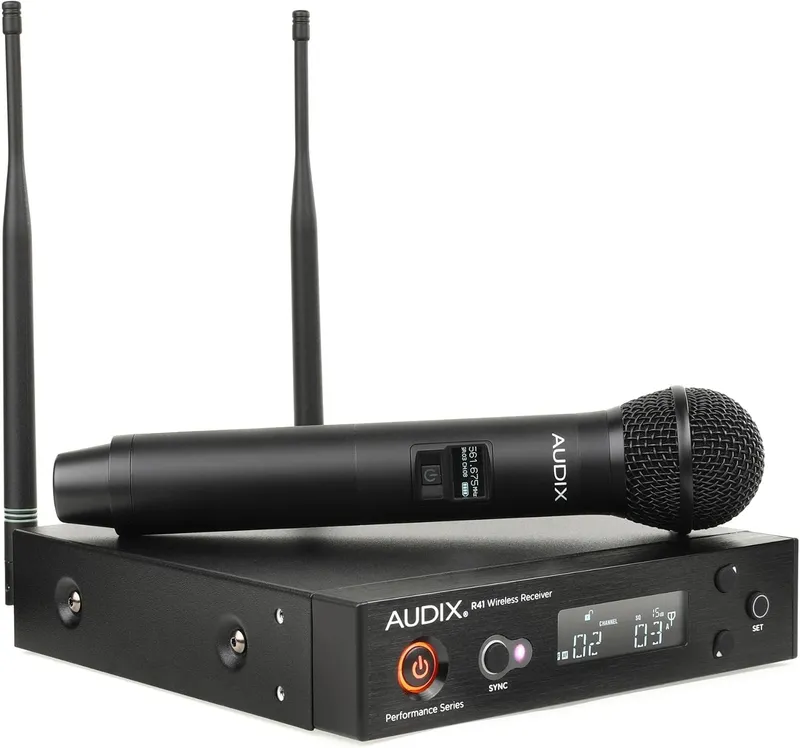
Best for: Vocalists who love the OM2’s studio presence and want it wireless.
- OM2 capsule: The venue-favorite Audix voicing with its tight, feedback-hostile pattern.
- AP41 true-diversity receiver: The Performance Series half-rack with a clear front display.
- Selective frequencies: Multiple channels for coordinated multi-mic stages.
- Metal handheld transmitter: The balanced, road-weight body with a power lock.
- Small-venue tuning: A system voiced for the rooms most singers actually play.
Pros:
- Capsule clarity that vocalists describe as hearing their own voice honestly.
- Reception that stays locked through theatrical stage movement.
- Build quality that justifies its place at the top of this ladder.
Cons:
- The steepest figure of the single-mic systems here.
- OM2’s tight pattern wants proper technique from the singer.
- Fewer band choices than the bigger wireless families.
Take Command of the AUDIX AP41 OM2
7. Phenyx Pro PTAU-2 Dual True Diversity Wireless Microphone System
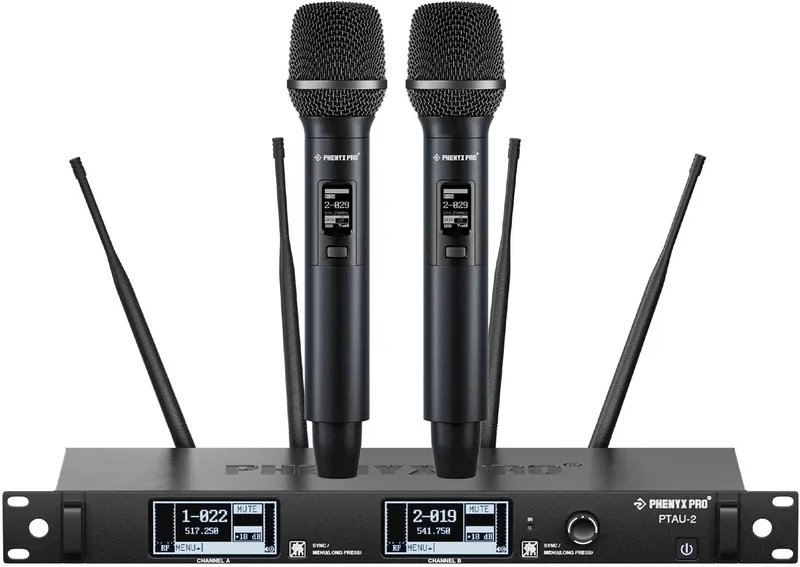
Best for: Duets, hosts, and co-fronted bands sharing one rack.
- Dual true diversity reception: Four antennas and independent chains that keep two voices gapless.
- Auto scan on both channels: The receiver finds clean frequencies for each mic separately.
- Two metal handhelds: Independent transmitters with individual displays and mute control.
- Rack-mount chassis: A one-space unit built to live in a permanent rig.
- Independent volume controls: Each voice balanced at the receiver, not the mixer.
Pros:
- The most complete two-singer coverage at a single-system figure.
- True diversity on both channels, a spec the legacy sets reserve for pricier tiers.
- Displays that read channel, frequency, and signal from across the stage.
Cons:
- Newer brand with a shorter venue track record.
- Dual system demands coordination discipline when adding a third mic.
- Handheld displays are small in dark rooms.
Run Two Voices with the Phenyx Pro PTAU-2
8. Xvive M5 Professional Wireless Handheld Microphone System
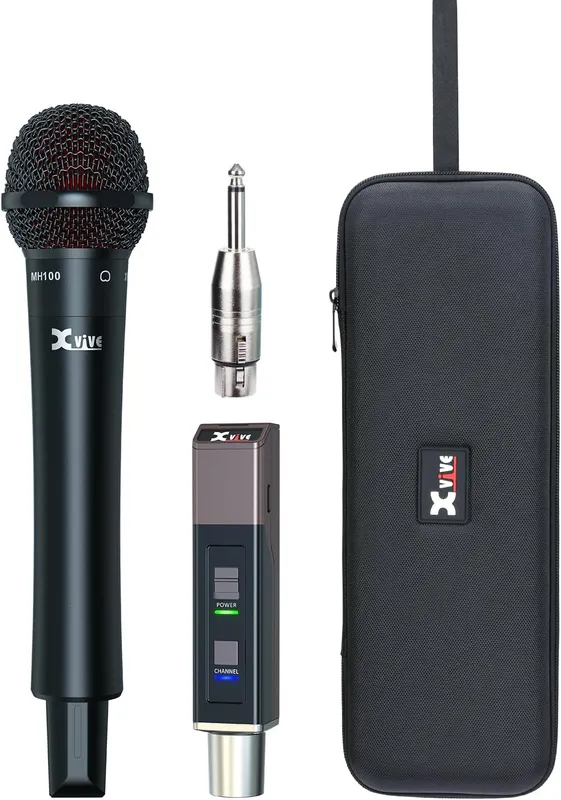
Best for: Singers who want modern convenience and a receiver that travels light.
- Built-in gain boost: The plus-six-decibel lift that lifts quiet voices to the desk.
- Compact plug-style receiver: The unit that sits at the desk or rides along to any venue.
- Channel selection onboard: Quick switching when the room’s airwaves are crowded.
- MH100 dynamic handheld: A balanced capsule with an on-body power and mute layout.
- Zippered travel case: Mic, receiver, and accessories in one padded pouch.
Pros:
- The gain boost that rescue-sings quiet singers without mixer surgery.
- The lightest complete kit here — ideal for open-mic circuits.
- Case included, which the legacy brands skip.
Cons:
- Shorter venue history than the legacy names.
- Receiver lacks rack-mount intent for permanent installs.
- Battery door feels lighter than the mic’s build.
Plug In and Play with the Xvive M5
9. CAD Audio WX200 UHF Dual Handheld Microphone System

Best for: Duos and karaoke nights that need two mics working from one box.
- Two synced handhelds: Independent UHF transmitters on separate fixed channels.
- Dual-channel receiver: Separate volume controls and indicators for each voice.
- LCD frequency readout: Both channels visible on the receiver face at a glance.
- Dynamic cardioid capsules: Two matching handhelds that share one sound signature.
- Two-mic economy: The whole front line covered for less than one legacy handheld.
Pros:
- The friendliest two-singer entry point in wireless, full stop.
- Fixed dual channels that never need coordination between the two mics.
- A genuine second microphone included, not a future purchase.
Cons:
- Fixed frequencies limit flexibility in crowded RF rooms.
- Transmitters feel lighter than the premium metal handhelds.
- No true-diversity antenna array on the receiver.
Hand Over the Second Mic with the CAD Audio WX200
Frequently Asked Questions
Q1: What should singers look for in the best wireless microphones for stage use?
A: Three things in order: reception design, capsule character, and frequency flexibility. Diversity antennas are what prevent the mid-song dropout, the capsule decides whether the wireless version sounds like the mic you chose, and selectable or auto-scanning frequencies keep the system usable when the venue’s airwaves are crowded. Get those three right and the rest is preference.
Q2: Do wireless microphones sound as good as wired ones?
A: Modern systems are close enough that audiences cannot tell — the capsule and the mix matter far more than the cable you removed. Digital systems pass an essentially untouched signal, and quality UHF units compress only gently. The honest differences show up at the edges: battery discipline, careful gain staging, and avoiding RF-crowded rooms matter more than any cable myth.
Q3: How much range does a stage singer actually need?
A: Far less than the spec sheet suggests. Most stages put the singer within fifty feet of the receiver even during the walkabout, and the two-hundred-foot-plus figures exist for line-of-sight in open air. What matters is clean reception through walls, pillars, and bodies — which is a diversity-antenna question, not a range-number question.
Q4: Can I run multiple wireless systems on one stage?
A: Yes, with one rule: every system needs its own clean frequency. Systems with selectable channels or auto-scan coordinate themselves in minutes, digital license-free units like the System 10 stack especially easily, and mixing bands — one UHF system plus one 2.4GHz digital — sidesteps the problem entirely. Five minutes of soundcheck discipline keeps any number of voices clean.
Q5: How do I stop my wireless mic from dropping out mid-show?
A: Antenna placement and fresh batteries solve most of it. Put the receiver high, in line of sight of the stage, with antennas spread rather than crossed against metal; start every show with fresh cells; and walk the stage at soundcheck listening for the weak spots so you know where the margins are. A true-diversity system in those conditions simply does not drop.
Final Verdict
Nine systems, one shared promise: the same voice from the front row to the loading dock. The Shure BLX24/SM58 and Sennheiser XSW 1-825-A carry the legacy capsules into the air, the Audio-Technica ATW-1102 makes it digital, the AKG WMS420 and AUDIX AP41 OM2 bring premium voicing, the Samson Concert 88x and CAD WX200 keep the entry honest, the Phenyx Pro PTAU-2 covers two singers in one rack, and the Xvive M5 travels lighter than them all. If you want the best wireless microphones for stage use for freedom without dropouts, don’t overthink it—these are already:
✔ Tested for reception stability, capsule character, and coordination on real stages with real crowds.
✔ Reviewed for the details singers feel first: mute feel, transmitter balance, and how each system behaves at soundcheck.
✔ Proven by touring vocalists, worship teams, and house venues whose mics hold the night from first song to encore.
Best Overall Pick – Shure BLX24/SM58
Best Budget – CAD Audio WX200
Best Premium – AUDIX AP41 OM2
Best for Two Singers – Phenyx Pro PTAU-2