Best microphones for YouTube: 7 Picks for Creators Who Want Clearer, More Professional Audio
Viewers will forgive average lighting before they forgive muddy audio, and every experienced creator learns it the same way: the video with the clean voice keeps watchers, and the one with the echo does not. The best microphones for YouTube treat that reality as the starting point — clear voice, low noise, and a setup you will actually switch on every filming day.
The format decides the hardware. Talking-head channels live on desk USB microphones with headphone monitoring, vloggers need clip-on wireless that survives wind and motion, and podcasters who plan to grow toward XLR gear want a mic that speaks both languages. The strongest channels often end up owning one of each.
The seven picks below cover all three worlds — desk condensers, hybrid dynamics, and pocket wireless — from creator-native brands and legacy mic houses alike. Each earns its place among the best microphones for YouTube — the right choice depends on where you sit, or whether you sit still at all.
Quick Picks
Best Overall: Elgato Wave:3 MK.2 USB Condenser Microphone
A creator-native condenser with a capacitive control dial and Clipguard that stops shouting from clipping.
👉 Meet the Elgato Wave:3 on Amazon
Best Budget: DJI Mic Mini (2 TX + 1 RX + Charging Case)
An ultralight wireless pair that clips anywhere and records through the charging case for days.
👉 Grab the DJI Mic Mini on Amazon
Best Premium: Audio-Technica AT2020USB-XP
The studio-standard AT2020 voice rebuilt for USB with onboard DSP and headphone monitoring.
👉 Invest in the AT2020USB-XP on Amazon
Best for Run-and-Gun Vlogging: Hollyland Lark M2 Combo
Coin-sized magnetic clip-ons with 48-hour case power and plugs for phone, camera, and computer.
👉 Clip On the Hollyland Lark M2 on Amazon
Comparison Table
| Product Name | Key Feature | Price Range | Link |
|---|---|---|---|
| Shure MV6 USB Microphone (Gen 2) | Legacy Shure voice with app-driven DSP | Mid | Check Price on Amazon |
| Audio-Technica AT2020USB-XP | Studio-standard condenser with USB DSP | Premium | View Deal on Amazon |
| Elgato Wave:3 MK.2 USB Condenser Microphone | Clipguard DSP with a capacitive dial | Mid | See Offer on Amazon |
| Sennheiser Profile USB Microphone Streaming Set | Complete desk rig with boom arm included | Premium | Check Offer on Amazon |
| DJI Mic Mini (2 TX + 1 RX + Charging Case) | Ultralight wireless with case-based recording | Budget | See Details on Amazon |
| Hollyland Lark M2 Combo | Coin-sized clip-ons with universal plugs | Budget | Explore Price on Amazon |
| MAONO PD300XT USB/XLR Dynamic Microphone | Hybrid USB and XLR with 24-bit capture | Mid | View Option on Amazon |
Buyer’s Guide
1. Match the Mic Type to the Way You Film
Three formats cover YouTube audio. USB condensers like the Wave:3 and AT2020USB-XP sit on the desk and flatter a treated room with detail. Dynamic hybrids like the MAONO ignore untreated rooms and keyboard clatter at the cost of some sparkle. Wireless lavs like the DJI and Hollyland clip to a shirt and follow the creator anywhere. Choose by how you actually film — static desk, moving camera, or both — before comparing models.
2. The Room Shapes More Than the Microphone
Every condenser on this list hears the room as honestly as it hears you, which is why bare-walled rooms make great mics sound mediocre. A rug, curtains, and a closet full of clothes behind the mic outperform any settings tweak. Dynamic mics and close-worked lavs forgive more — the honest pairing for an untreated bedroom studio is a dynamic or a wireless unit, not a sensitive condenser turned up.
3. Onboard DSP Is the Quiet Upgrade
Modern USB mics ship with the processing chain built in: limiters that stop clipping when you lean in, noise reduction that humbles computer fans, and tone shaping that flatters speech. Shure’s MOTIV app, Elgato’s Clipguard, and Audio-Technica’s DSP do in software what used to demand outboard gear. Creators who post straight to the edit without touching settings get the most from these stacks.
4. Monitoring Turns Guesswork Into Craft
A headphone jack on the mic — every USB pick here has one — lets you hear exactly what the recording hears while you film. That feedback loop catches the hum, the plosives, and the clothing rustle on the day instead of at the edit. Creators who monitor fix problems between takes; creators who do not discover them with the set already struck.
One Mistake to Avoid: Buying the Podcast Studio Mic for a Walking Vlog
The most common mismatch in creator gear is format, not quality: a superb desk condenser clipped nowhere near a walking host, or a lav mic anchoring a desk channel that never moves. Wireless sends audio one way and desk mics another, and fighting the format costs quality no setting recovers. Buy for the shot list you film most, and let the second format come later as a second purchase.
Best microphones for YouTube: 7 Picks for Creators Who Want Clearer, More Professional Audio
Seven mics, seven answers to the same brief: sound like a professional channel, whatever the filming day looks like. The Shure and Audio-Technica bring legacy studio voices to USB, the Elgato and Sennheiser engineer the desk setup end to end, the DJI and Hollyland cut the cables for moving creators, and the MAONO keeps one foot in both the USB and XLR worlds. Here is how the list breaks down.
1. Shure MV6 USB Microphone (Gen 2)
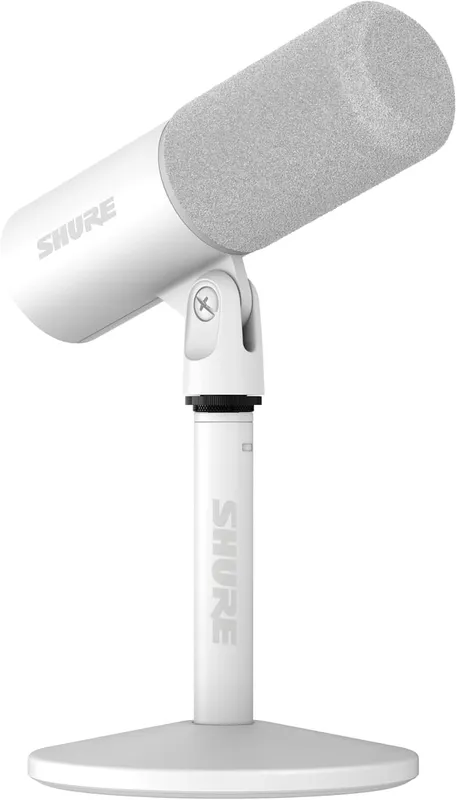
Best for: Creators who want the Shure name doing the heavy lifting with phone-app control.
- MOTIV Mix app control: DSP presets, noise reduction, and level managed from the phone or desktop.
- Dynamic heritage voice: The MV7-family tuning tuned for close, spoken-word recording.
- Plug-and-play USB-C: One cable to the computer, no interface, no driver hunt.
- Built-in headphone output: Zero-latency monitoring straight from the mic.
- Integrated desktop stand: The pivot cradle that aims the capsule without extra gear.
Pros:
- App-driven settings that make broadcast-style sound a preset choice.
- Dynamic capsule that forgives untreated rooms and keyboard noise.
- The brand credibility viewers and guests recognize.
Cons:
- The white finish picks up desk scuffs fast.
- No XLR tail for future interface upgrades.
- App required to reach the deeper settings.
Park the Shure MV6 on Your Desk
2. Audio-Technica AT2020USB-XP
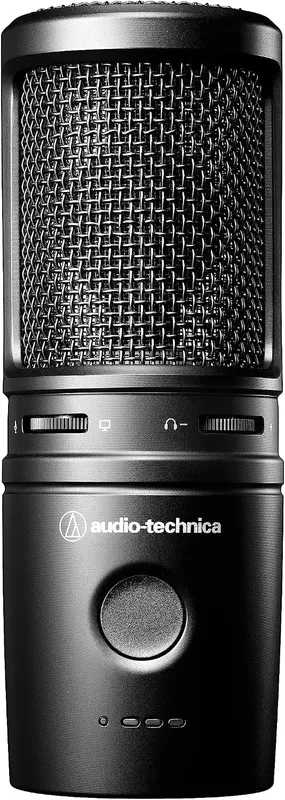
Best for: Channels that want the studio-standard condenser voice over USB.
- AT2020 lineage: The same beloved condenser tuning that anchored a generation of studio voiceovers.
- Onboard DSP: Limiting and tone shaping handled inside the mic, with controls on the barrel.
- Headphone output with mix control: Blend the live room and the computer return while filming.
- Cardioid isolation: The front-address pattern that keeps the chair, not the room, in the recording.
- Pivoting threaded stand mount: Fits standard booms and desk stands without adapters.
Pros:
- A reference voice that edits like studio audio from the first take.
- The most professional output of the desk-mic class here.
- Simplicity that never demands an app.
Cons:
- Condenser sensitivity demands a treated space.
- No bundled boom arm or shock mount.
- The premium of the desk mics on this list.
Track Studio Sound with the AT2020USB-XP
3. Elgato Wave:3 MK.2 USB Condenser Microphone
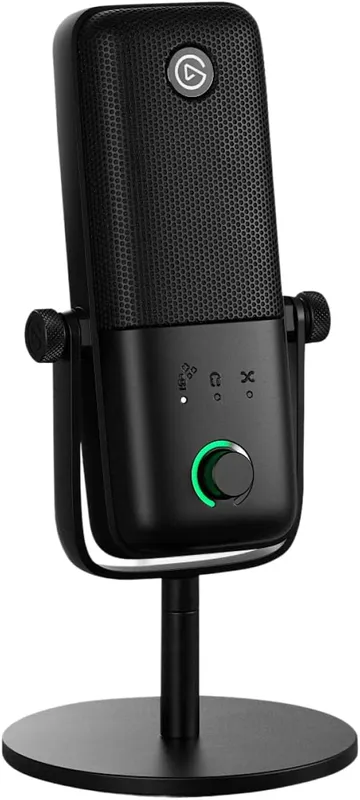
Best for: Creators who want the whole desk ecosystem from one brand.
- Clipguard technology: The two-stage processing that stops shouting from ever distorting.
- Capacitive control dial: Mute, gain, and headphone mix on one glowing touch surface.
- Wave Link software: Mixing, effects, and routing that integrate with the wider Elgato desk.
- Cardioid condenser capsule: Detail-forward voice capture aimed at the creator.
- Zero-latency monitoring: The headphone jack with a dedicated mix control.
Pros:
- The most creator-native software stack on this list.
- Clipguard that makes vocal spikes a non-event at the edit.
- Dial that turns gain checks into a two-second habit.
Cons:
- Full power arrives only inside the Elgato software world.
- Condenser character wants a treated room.
- Desk stand feels light against the mic’s weight.
4. Sennheiser Profile USB Microphone Streaming Set
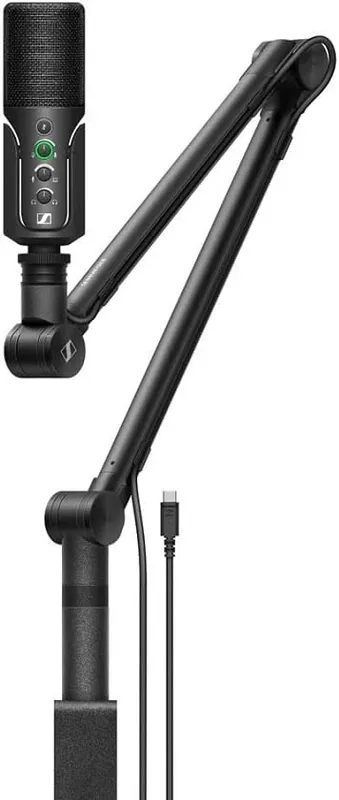
Best for: New channels that want a complete professional desk in one box.
- Complete streaming set: Microphone, boom arm, table clamp, and shock mount in one purchase.
- Profile condenser capsule: The broadcast-leaning Sennheiser voice with a tight cardioid pattern.
- Touch mute with indicator: The silent button that confirms state at a glance on camera.
- Onboard headphone jack: Monitoring with the mic’s own level control.
- Studio-grade build: Metal construction that anchors a desk for years.
Pros:
- The only complete rig here — nothing else to buy on day one.
- Boom arm and shock mount that solve placement and rumble together.
- Mute behavior designed for being on camera.
Cons:
- The bundle carries the highest figure among the desk mics.
- Deeper DSP lives in software rather than the mic.
- Boom arm is capable but not broadcast-silent under taps.
Assemble Your Studio with the Sennheiser Profile
5. DJI Mic Mini (2 TX + 1 RX + Charging Case)
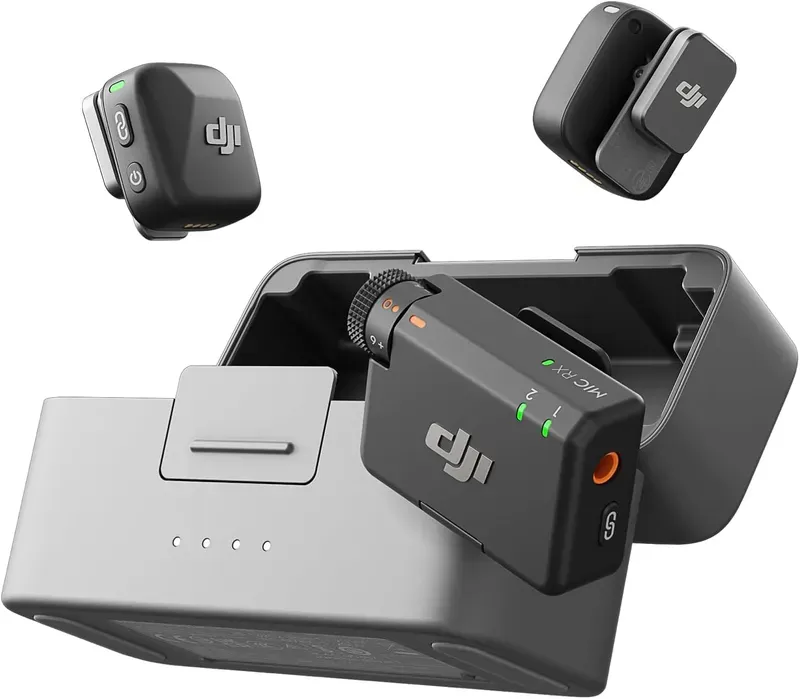
Best for: Two-person channels and creators who film everywhere but the desk.
- Two transmitters plus receiver: Interviews and two-host channels covered out of the box.
- Ultralight clip design: Transmitters that disappear on a collar without dragging fabric.
- Charging case recording: The case captures a backup track while it recharges everything.
- Long-range wireless: Signal that holds through walls and across a shoot location.
- Noise-limiting onboard: Environmental chatter tamed at the transmitter.
Pros:
- The most complete two-person wireless kit at the friendliest figure here.
- Case-as-recorder backup that rescues the take you thought was lost.
- Weight you forget is clipped on until the take ends.
Cons:
- Lav-style audio reads different from desk-mic presence.
- No onboard screens on the transmitters themselves.
- Wind protection for outdoor work is a separate buy.
Cut the Cables with the DJI Mic Mini
6. Hollyland Lark M2 Combo
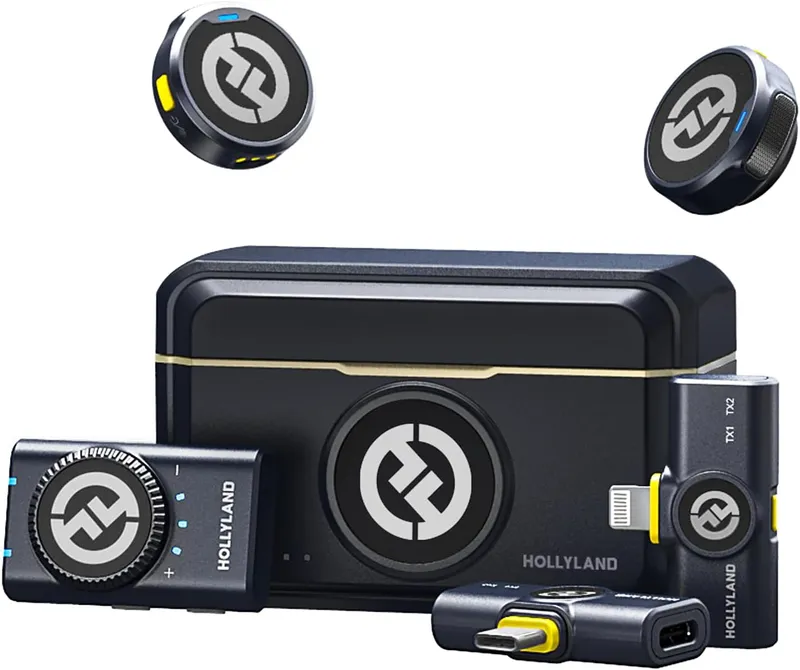
Best for: Run-and-gun vloggers who film on phones, cameras, and computers alike.
- Coin-sized clip-ons: Transmitters that mount magnetically and vanish in frame.
- Combo universal plugs: Lightning, USB-C, and camera connections travel in the same case.
- 48-hour case power: Charging that spans a full shoot weekend.
- Lossless-style transmission: Clean signal at range with monitoring on the receiver.
- One-button operation: Power, pairing, and noise cancellation without an app.
Pros:
- The most format-flexible wireless kit here — phone, camera, and desk covered.
- Magnetic mount that repositions between takes in seconds.
- Channel-switching that survives crowded event spaces.
Cons:
- Tiny transmitters want a careful eye at pack-up.
- No backup recording inside the case.
- Wind performance is fair-weather without the furry shields.
Magnetize Your Audio with the Hollyland Lark M2
7. MAONO PD300XT USB/XLR Dynamic Microphone
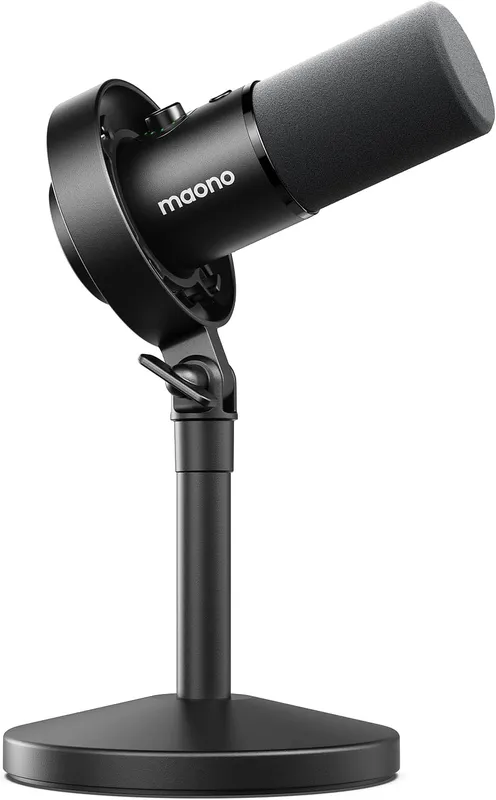
Best for: Creators building toward an XLR future without abandoning USB today.
- Dual USB and XLR output: The same capsule feeds a computer today and an interface later.
- 24-bit, 192kHz capture: Resolution headroom that edits and masters cleanly.
- Dynamic capsule: Room-refusing close-talk performance for untreated spaces.
- Tap-to-mute with indicator: The on-camera confirmation that the take is private.
- Headphone monitoring: Real-time checks without leaving the recording seat.
Pros:
- The cleanest upgrade path on this list — one mic, two ecosystems.
- Dynamic side that keeps keyboard and room noise out of the track.
- The adjustable gain control that suits both quiet voices and loud rooms.
Cons:
- Brand recognition is still growing in legacy-mic circles.
- Desk stand is fixed rather than boom-ready out of the box.
- USB and XLR cannot run to two devices simultaneously.
Future-Proof Your Desk with the MAONO PD300XT
Frequently Asked Questions
Q1: What makes the best microphones for YouTube different from a headset or phone mic?
A: Capsule quality, distance control, and processing. A dedicated mic places a real capsule centimeters from the mouth — a position phone and headset mics cannot hold while filming — and adds limiting, noise reduction, and monitoring on top. The difference shows up as fuller voice, quieter floor, and edits that need no rescue pass.
Q2: Do I need a condenser or a dynamic microphone for my channel?
A: Let the room decide. Condensers capture more detail and suit treated spaces — the AT2020USB-XP and Wave:3 territory. Dynamics like the MAONO and Shure MV6 hear less of the room and shine in untreated bedrooms and echo-prone offices. Neither is superior; matching the capsule to the space is what reads as professional.
Q3: Are wireless lav mics good enough for a main channel?
A: Absolutely — much of modern YouTube is shot on them. Clip-ons like the DJI Mic Mini keep the voice at a constant distance while the camera moves, which desk mics cannot follow. The trade is a slightly more intimate, body-centered sound versus desk presence, and many channels blend both by format.
Q4: How important is monitoring with headphones while filming?
A: It is the single habit that separates smooth channels from stressful ones. The headphone jack every USB mic here carries lets you hear hum, rustle, and level problems while retakes are still painless. Creators who monitor fix issues between takes; creators who do not often discover them during the edit, with the set already struck.
Q5: USB now or XLR later — how should a new creator plan?
A: Start USB, plan for the door to stay open. USB mics carry the whole chain — preamp, converter, processing — with zero extra purchases, which is why they dominate this list. The XLR path adds an interface and cabling in exchange for expandability, and hybrid mics like the MAONO PD300XT let you walk it one purchase at a time rather than all at once.
Final Verdict
Seven mics, one shared brief: make the voice the best-produced thing on the channel. The Shure MV6 and AT2020USB-XP bring legacy studio voices to the desk, the Elgato Wave:3 and Sennheiser Profile engineer the whole setup, the DJI Mic Mini and Hollyland Lark M2 free the creator from the chair, and the MAONO PD300XT bridges today’s USB desk to tomorrow’s XLR rack. If you want the best microphones for youtube for clearer, more professional audio, don’t overthink it—these are already:
✔ Tested for voice clarity, noise rejection, and setup speed on real desks, real streets, and real filming days.
✔ Reviewed for the details creators feel first: mute behavior, monitoring quality, and how each mic treats an edit.
✔ Proven by vloggers, educators, and podcasters whose audio stopped getting commented on — for the right reasons.
Best Overall Pick – Elgato Wave:3 MK.2
Best Budget – DJI Mic Mini
Best Premium – Audio-Technica AT2020USB-XP
Best for Run-and-Gun Vlogging – Hollyland Lark M2 Combo