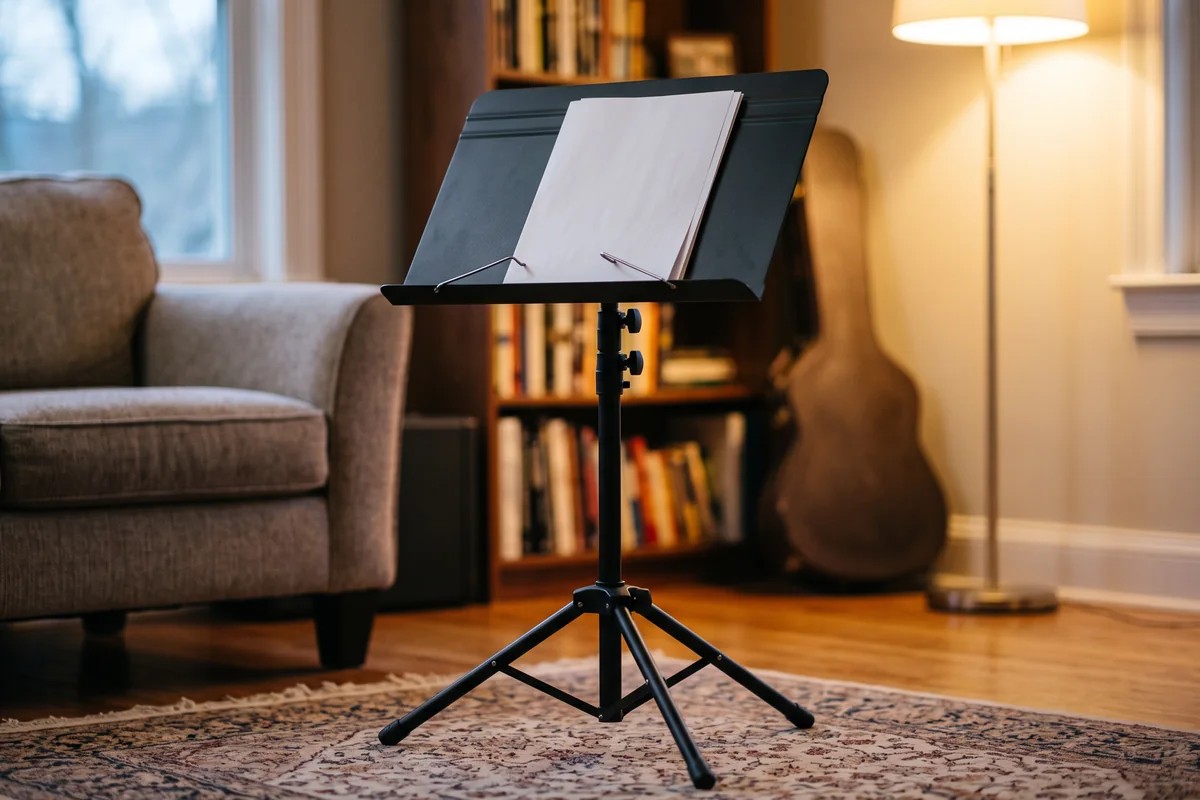
Best sheet music stands: 8 Picks for Musicians Who Need Stable, Easy-to-Read Setup
A music stand has one job — hold your music still, at the right height, while you look at it — and the difference between a good one and a frustrating one shows up within the first page. Wobbly legs, a desk that slowly tilts under a heavy book, or a lip too shallow for a real score will derail rehearsal faster than a broken string. The best sheet music stands make the hardware disappear so your eyes stay on the notes.
Stability and readability start with three things: a base that refuses to creep, a desk deep enough to carry a full score with a firm lip, and a height-and-tilt range that matches whether you play seated, standing, or conducting from a podium. Add the right extras — a carry bag, a clip light, a desk that folds flat — and the stand becomes part of the routine instead of a fight.
The eight picks below span that whole map, from the stand every school orchestra knows to folding travelers that vanish into a gig bag. Each one earns its place among the best sheet music stands — the right pick depends on whether yours lives in a practice room or the trunk of a car.
Quick Picks
Best Overall: Manhasset 48 Symphony Music Stand
The school and orchestra standard, made in the USA, with a one-piece column and a desk that holds its angle for decades.
👉 Meet the Manhasset 48 on Amazon
Best Budget: K KASONIC 2-in-1 Folding Sheet Music and Book Stand
A featherweight folder with its own carry bag that sets up anywhere for the cost of a pack of strings.
👉 Start with the K KASONIC on Amazon
Best Premium: Hercules BS200B Symphony Music Stand
A full-size symphony desk with a one-hand height clutch that moves smoothly and locks without wobble.
👉 Step Up to the Hercules BS200B on Amazon
Best for Dark Stages: Donner DMS-1 Sheet Music Stand with Light and Carrying Bag
A full kit in one box: adjustable stand, USB clip light, sheet holder, and a padded travel bag.
👉 Light Up the Donner DMS-1 on Amazon
Comparison Table
| Product Name | Key Feature | Price Range | Link |
|---|---|---|---|
| Manhasset 48 Symphony Music Stand | The USA-made orchestra standard column | Premium | Check Price on Amazon |
| Hercules BS200B Symphony Music Stand | One-hand height clutch under a full symphony desk | Premium | View Deal on Amazon |
| Gator Frameworks GFW-MUS-0500 Recital Series Music Stand | Perforated lightweight desk with tilt range | Mid | See Offer on Amazon |
| On-Stage SM7222BB Tripod-Base Sheet Music Stand with Bag | Classic folding wire desk with a carry bag | Mid | Check Offer on Amazon |
| Vekkia Metal Professional Portable Perforated Sheet Music Stand | Rigid perforated steel in a portable kit | Mid | See Details on Amazon |
| Donner DMS-1 Sheet Music Stand with Light and Carrying Bag | Clip light and bag bundled in the box | Budget | Explore Price on Amazon |
| CAHAYA Dual-Use Sheet Music Stand | Converts from floor stand to desktop stand | Budget | View Option on Amazon |
| K KASONIC 2-in-1 Folding Sheet Music and Book Stand | Folds flat for books and scores alike | Budget | Check Details on Amazon |
Buyer’s Guide
1. Stability Starts at the Base
Everything else about a stand is secondary to whether it stays put when you turn a page with one hand. Wide-spread tripod legs with real contact points handle carpet, stage risers, and the occasional hip-check; the Manhasset’s cast base takes a different route, using weight and geometry that never learn to wobble. Check where the column meets the legs, too — that joint takes every bit of torque a leaning score can deliver.
2. Desk Depth and Lip Height Hold the Pages
A deep desk carries a full open score without the corners curling off the edges, and a firm lip keeps pages from sliding mid-phrase. Perforated steel desks like the Vekkia’s and Gator’s cut weight without cutting rigidity, and the holes kill glare under stage lighting. Wire-rack folding desks trade some of that authority for packability, which is exactly the trade portable stands are built to make.
3. Height Range and Tilt Decide Sight Lines
The best stand is the one that puts the music level with your eyes, not your hands. Seated players need a range that dips low; standing brass and strings need reliable height with the desk staying square under a full tilt. A clutch that adjusts with one hand — the Hercules signature — turns mid-rehearsal corrections into a two-second fix instead of a wrestle.
4. Portability Is a Trade, Not a Given
Every folding stand gives up some rigidity to collapse into a bag, and every one-piece column like the Manhasset’s gives up trunk space to stay solid. Neither is wrong — they are different purchases. Decide honestly whether the stand will live in a corner of a practice room or travel every week, and let that answer pick the category before you compare models.
One Mistake to Avoid: Asking a Folding Stand to Do a Symphony Stand’s Job
The temptation is real: a twenty-dollar folder looks like the same tool as a heavyweight column until the first orchestral score lands on it. Wire desks flex under thick books, light legs wander across the stage mid-phrase, and the whole unit develops a shimmy that reads from the back row. Buy the folder for travel and the column for the room it will live in — the mistake is pretending one stand can be both.
Best sheet music stands: 8 Picks for Musicians Who Need Stable, Easy-to-Read Setup
Eight stands, eight answers to the same demand: hold the music still and make it easy to read. The Manhasset defines the category, the Hercules adjusts it with one hand, the Gator and Vekkia lighten it without losing the desk, the On-Stage folds with a bag, the Donner brings its own light, the CAHAYA converts to a desktop unit, and the KASONIC packs the whole idea into a backpack. Here is how the list breaks down.
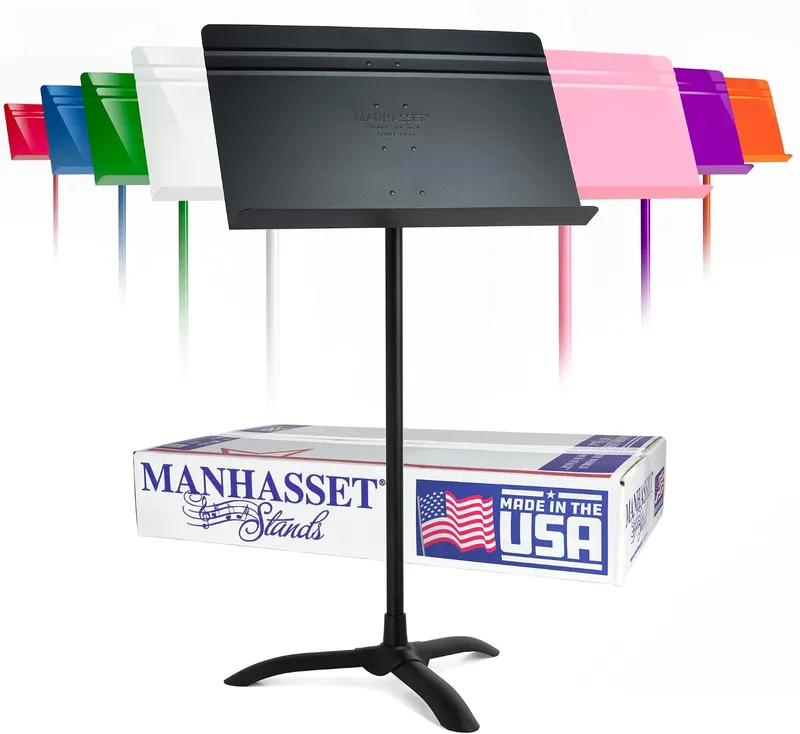
1. Manhasset 48 Symphony Music Stand
Best for: Schools, orchestras, and anyone furnishing a room with the final word in stands.
- One-piece column: The famous friction clutch that holds height and angle without knobs or wobble.
- The 48 desk: Deep, slightly angled, and famous for holding a full score square for decades.
- Cast four-legged base: Weighted geometry that plants the stand and stays planted.
- Made in the USA: The original Connecticut-built standard music rooms run on.
- Instantly recognizable profile: The silhouette conductors, teachers, and students all know at a glance.
Pros:
- The most trusted stand in the world, and the one every other stand gets compared to.
- Height and angle hold through years of daily abuse.
- Resale and hand-me-down value that outlives the purchase.
Cons:
- One-piece build means nothing folds into a car trunk.
- Costs several folding stands’ worth of money.
- Desk lip is shallow for very thick books.
Anchor Your Section with the Manhasset 48
2. Hercules BS200B Symphony Music Stand
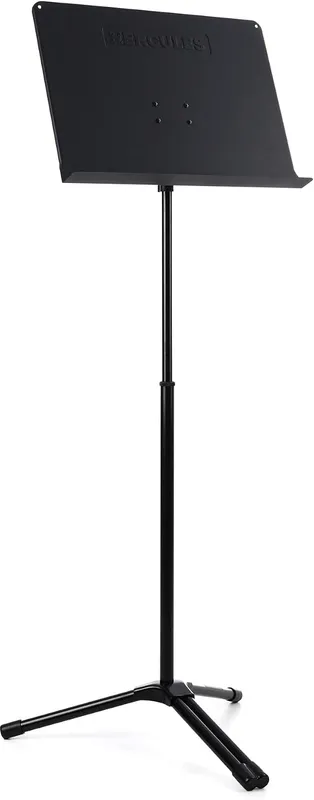
Best for: Players who want symphony-grade hardware that adjusts with one hand.
- One-hand height clutch: Squeeze, slide, done — the column locks square at any height.
- Full symphony desk: A big, rigid surface with a tilt range from flat to performer angle.
- Folding tripod legs: Collapse for storage while keeping a planted, stable stance.
- Reinforced column joint: The stress point most stands fail at, overbuilt here.
- Hercules hardware pedigree: The same engineering culture behind their instrument stands.
Pros:
- Fastest height change of any full-size stand here.
- Desk rigidity that genuinely rivals the Manhasset.
- Folds for storage without giving up stage presence.
Cons:
- No carry bag included.
- Column is a two-piece lift, not one continuous tube.
- Slight rock in the desk at extreme tilt settings.
Conduct Your Setup with the Hercules BS200B
3. Gator Frameworks GFW-MUS-0500 Recital Series Music Stand
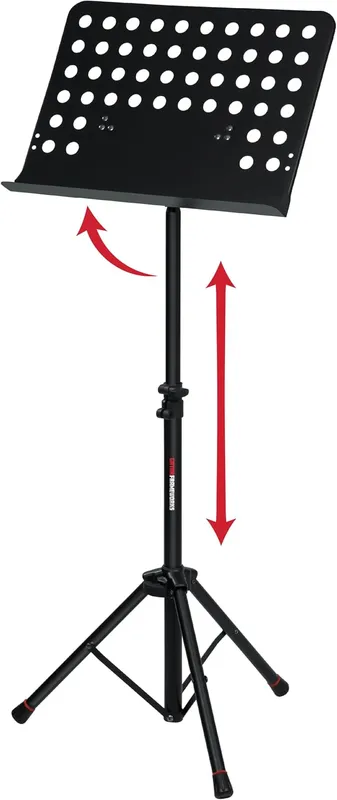
Best for: Recital rooms and teaching studios that want rigid desks without the weight.
- Perforated steel desk: Cuts weight, kills glare, and stays rigid under a full score.
- Wide tilt range: The desk pivots from near-flat to steep reading angles.
- Reliable friction height lock: Holds position without creeping under load.
- Folding tripod: Quick setup and teardown between rooms.
- Gator build culture: Touring-case engineering applied to a stand.
Pros:
- The best rigidity-to-weight ratio in the portable class here.
- Desk that reads as professional in a recital hall.
- Setup that takes seconds and never fights you.
Cons:
- No bag or accessory in the box.
- Height ceiling is lower than the symphony columns.
- Perf holes collect dust in storage.
Raise Your Rig with the Gator Recital
4. On-Stage SM7222BB Tripod-Base Sheet Music Stand with Bag
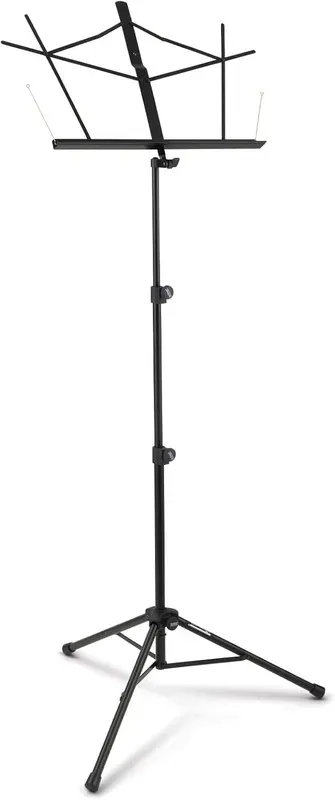
Best for: Working musicians who need a folding stand that ships with a bag.
- Classic folding wire desk: The proven design that collapses completely flat.
- Tripod base with real spread: More planted than the featherweight folders.
- Carry bag included: Shoulder-strap storage in the same purchase.
- Wide height range: From seated reading to standing performance positions.
- On-Stage availability: A hardware-store-familiar brand with easy replacement parts.
Pros:
- The complete folding package — stand plus bag — at a working-player weight.
- Proven design that schools and churches have used for years.
- Sets up and tears down in under a minute.
Cons:
- Wire desk flexes under heavy books.
- Legs wander slightly on polished floors.
- Lip holds thin scores better than thick anthologies.
Fold It into the Car with the On-Stage SM7222BB
5. Vekkia Metal Professional Portable Perforated Sheet Music Stand
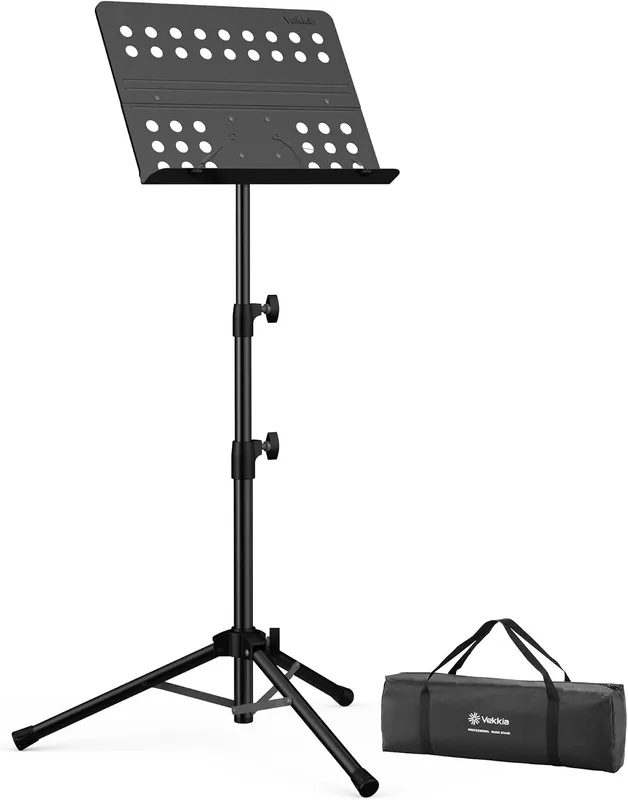
Best for: Travelers who want portable hardware that still feels professional.
- Perforated steel desk: Full-size rigidity at a portable weight, with glare-cutting holes.
- Carry bag included: The whole kit travels in a fitted shoulder bag.
- Two-point height locks: Separate clamps keep column height and desk angle honest.
- Reinforced desk fold: Hinges that hold their shape after repeated packing.
- Steady tripod stance: Wider foot spread than the entry-level folders.
Pros:
- Professional feel in a bag that fits beside a guitar case.
- Desk that stays square where wire folders start to bend.
- Complete travel kit with nothing extra to buy.
Cons:
- Heavier than the wire-desk folders.
- Brand is newer to the pro scene.
- Desk lip is modest for thick scores.
6. Donner DMS-1 Sheet Music Stand with Light and Carrying Bag
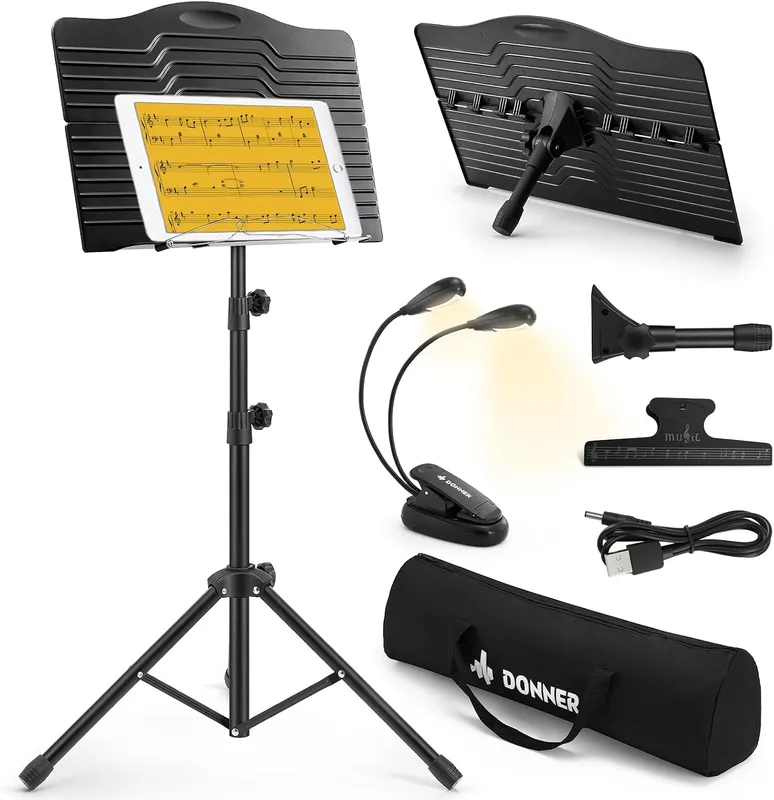
Best for: Gigging players who rehearse and perform in dim rooms.
- USB clip light bundled: The dual-arm light charges over the same cable as everything else.
- Sheet holder clip: Keeps loose pages flat when the fan or the drums push air around.
- Padded carrying bag: The stand, light, and clip travel as one unit.
- Two-tier height locks: Column and desk adjust independently and stay put.
- Folding steel desk: Rigid panel design that packs flat.
Pros:
- The only complete dark-stage kit here — stand, light, clip, and bag in one box.
- Light that actually covers a full score, corner to corner.
- Depth of accessories that no rival at this level matches.
Cons:
- Stand alone is more ordinary than the bundle suggests.
- Light needs charging on a schedule like any USB device.
- Bag padding is thin for checked-luggage abuse.
Brighten Your Sets with the Donner DMS-1
7. CAHAYA Dual-Use Sheet Music Stand
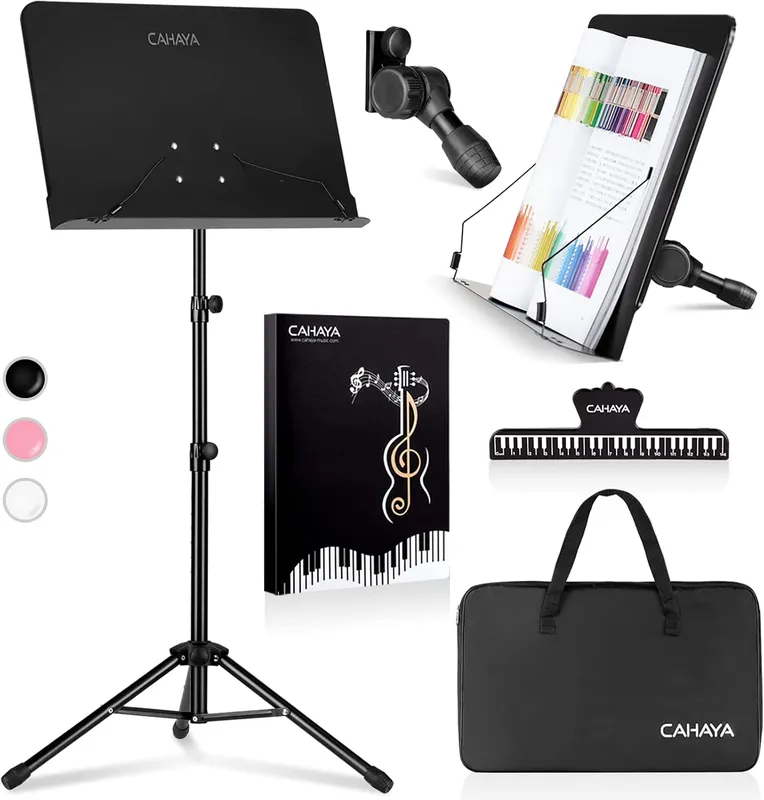
Best for: Players who split time between a practice room and a desk.
- Two stands in one: The desk unit converts from the floor tripod to a desktop stand.
- Carry bag included: Both configurations travel together.
- Adjustable floor height: Covers seated and standing positions on the tripod.
- Deep solid desk: A rigid panel that holds books as happily as sheet music.
- Color options: Classic black plus softer finishes for home setups.
Pros:
- Genuinely two products: full floor stand plus desktop reader.
- The desktop mode suits guitar lessons and laptop-side practice.
- Bag that swallows the whole system.
Cons:
- The conversion hinge adds a flex point the single-unit stands lack.
- Desk tilt stops are coarse.
- Hardware bag has no labeled pockets.
Convert Your Setup with the CAHAYA Dual-Use
8. K KASONIC 2-in-1 Folding Sheet Music and Book Stand
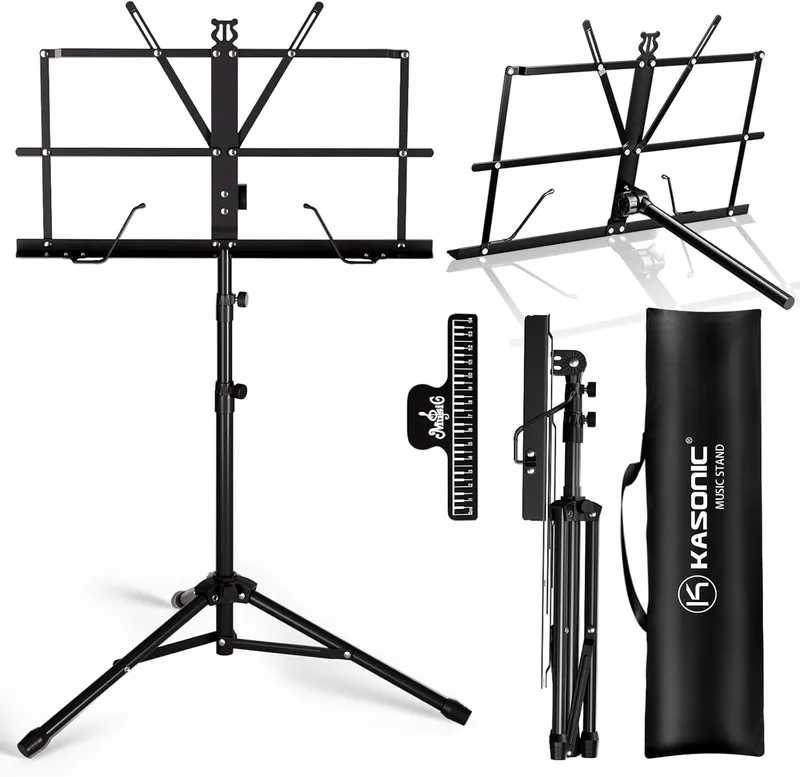
Best for: Students, travelers, and anyone who wants a stand in every bag.
- Folds completely flat: The whole stand collapses thinner than a laptop.
- Carry sleeve included: Slides into a backpack or instrument case pocket.
- Two-in-one design: Serves as a music stand and a reading or cookbook stand.
- Feather build: Light enough for kids to carry themselves.
- Adjustable floor height: Tripod reach covers seated and standing use.
Pros:
- The easiest stand to own twice — one for home, one for the bag.
- A ticket that makes outfitting a whole classroom realistic.
- Honest utility for books and tablets, not just sheet music.
Cons:
- Lightest build here — treat it gently.
- Wire desk flexes under heavy scores.
- Height stability depends on a careful setup.
Pack One Everywhere with the K KASONIC
Frequently Asked Questions
Q1: What separates the best sheet music stands from a basic folding stand?
A: Stability, desk authority, and adjustment quality. The better stands plant a base that never wanders, carry a full score on a rigid desk with a real lip, and hold their height and angle through an entire rehearsal. Basic folders trade each of those traits for packed size — which is fine for travel and wrong for a room you play in daily.
Q2: Are perforated metal desks actually better than solid ones?
A: They earn their holes. Perforation drops weight without dropping rigidity, and it removes the glare that solid glossy desks throw back under stage and window light. Solid desks still win for absolute stiffness — which is why the premium symphony class uses them — but for portable stands, perforated steel is the smarter material.
Q3: How tall should a stand adjust for standing players?
A: Look for a desk platform that reaches roughly eye level while you stand upright — for most adults that means the desk surface landing somewhere around chest-to-chin height at its maximum. Check the maximum before buying, not the folded size: a stand that tops out low forces a permanent hunch, and that is the fastest way to stop using it.
Q4: Do clip-on stand lights work on any desk?
A: Almost always — the springs are generous — but desk thickness matters at the extremes. Wire racks need the light clipped to the center strut rather than a thin wire, and thin panel desks benefit from a light with a wider jaw. A bundled option like the Donner’s removes the guesswork because the jaw and the desk were designed together.
Q5: Is a carry bag worth prioritizing?
A: If the stand travels at all, yes. Bags protect finishes, keep folding hardware from catching on other gear, and make the difference between grabbing the stand and leaving it behind. Stands like the On-Stage, Vekkia, Donner, and CAHAYA include one; for column-style stands like the Manhasset, the bag is usually a separate purchase — plan for it.
Final Verdict
Eight stands, one shared promise: the page stays where you put it. The Manhasset 48 remains the room-furnishing standard, the Hercules adjusts like a precision instrument, the Gator and Vekkia lighten the idea without losing the substance, the On-Stage folds with a bag, the Donner lights its own pages, the CAHAYA doubles as a desktop reader, and the KASONIC makes owning a stand everywhere realistic. If you want the best sheet music stands for stable, easy-to-read setup, don’t overthink it—these are already:
✔ Tested for base stability, desk rigidity, and height lock on real stages, in studios, and across a season of rehearsals.
✔ Reviewed for the details players feel first: clutch feel, lip grip, and how each desk treats a heavy score.
✔ Proven by orchestras, students, and working bands whose music stays put night after night.
Best Overall Pick – Manhasset 48 Symphony Stand
Best Budget – K KASONIC Folding Stand
Best Premium – Hercules BS200B
Best for Dark Stages – Donner DMS-1